Concrete Services
Concrete Contractor — Footings, Slabs & Flatwork
Good concrete is 80% preparation. Compacted base, correct thickness, proper reinforcement, controlled joints in the right places, and a finish and cure that suit the weather that week — that is why some slabs last decades and others map-crack in a season.
Overview
Concrete That Was Built From The Subgrade Up
Concrete is the most permanent thing most property owners buy, and the easiest to get wrong invisibly. Nobody can see whether the base was compacted, whether the rebar was chaired up off the ground or laid in the dirt, whether the mix was right for the exposure, or whether control joints were cut deep enough and soon enough. You find out two winters later.
Beast Construction Inc does concrete as part of a complete site scope, which means the same company that compacts your subgrade pours on top of it. Footings and foundation walls, monolithic and slabs on grade, garage and shop floors, driveways and aprons, sidewalks and ADA ramps, patios and pads, steps and stoops, curb and gutter, equipment and generator pads, dumpster pads and commercial flatwork.
We form to line and grade, place reinforcement per the plan or good practice, specify a mix and air content suited to the exposure and the state we are working in, finish appropriately for the use, cut or tool joints on a proper spacing, and cure the concrete instead of walking away from it. Pair it with our excavation, grading and drainage and hardscape work for a single-source exterior package.
Footings, Foundations & Structural Concrete
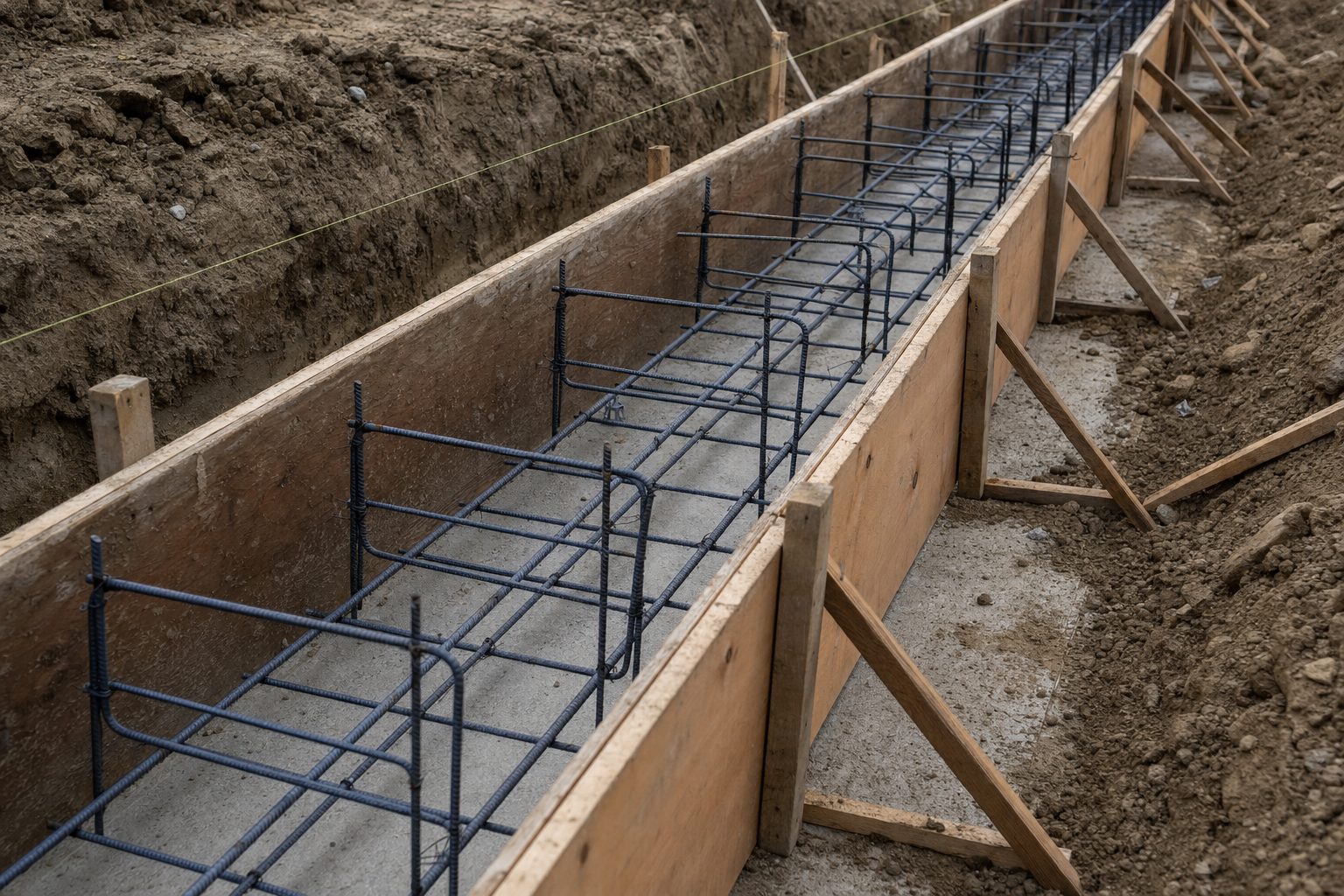
Structural concrete is where inspection and engineering matter most. We excavate and form footings to the specified width, depth and bearing elevation, set rebar with proper cover and laps, install dowels and anchor bolts to plan, and pour on undisturbed or properly compacted bearing soil — never on loose spoil. Foundation walls are formed plumb and braced, tied per the drawings, and waterproofed or damp-proofed with drainage board and footing drains where the design calls for it.
We also handle stem walls, grade beams, pier and column footings, frost walls for additions and outbuildings, retaining wall footings, and slab-on-grade turndowns. Because we install the footing drains and backfill ourselves, the drainage detail actually gets built the way it was drawn — which is the single biggest factor in whether a basement stays dry.
Slabs, Garage & Shop Floors
A durable slab starts with a compacted stone base, vapor retarder where required, correct thickness for the loading, and reinforcement that stays where it belongs during the pour. For residential garages and shops we typically place a heavier slab than the minimum with thickened edges at overhead door openings and vehicle loading, tool or saw-cut control joints at proper spacing, and pitch the floor toward the door or a floor drain so water leaves the building.
Commercial and agricultural slabs get designed for the actual loads: forklifts, equipment, storage racking, livestock, wash-down, or heavy truck traffic. Options include broom, hard trowel, exposed aggregate and shake-on hardener finishes, plus sealers appropriate to the exposure. Pouring inside a new pole barn or metal building? We can do the pad, the slab and the building on one contract.
Driveways, Sidewalks, Patios & Steps
Concrete driveways succeed or fail on base preparation, thickness, jointing and drainage. We remove and replace failed pavement, compact and stone the base, form to fall water away from the garage, reinforce, and cut joints on a spacing appropriate to the slab. For homeowners choosing between concrete and asphalt, our driveway page lays out the real trade-offs in cost, climate and maintenance rather than pushing one product.
Sidewalks, walkways, patios, porches, steps and stoops round out the residential flatwork we do most. Finish options include broom, exposed aggregate, saw-cut patterns, stamped and integrally colored concrete. Where a patio or walk would be better in paver or stone, we will say so — our hardscape crews build those too, so there is no incentive to sell you the wrong material.
Repair, Replacement & Commercial Flatwork
Not every cracked slab needs replacement. We evaluate whether a slab can be repaired with joint and crack routing and sealing, partial-depth patching, grinding of trip hazards, or slab-jacking, versus when removal and replacement is genuinely the better spend. Deteriorated surfaces from freeze-thaw scaling or de-icing salts often signal a mix or finishing problem in the original pour that a patch will not fix.
For commercial clients we pour curb and gutter, sidewalks and ADA-compliant ramps and landings, dumpster and loading pads, light pole and equipment bases, bollards, and parking lot flatwork — coordinated with our commercial construction and site utility scopes so nothing gets poured over an unfinished sleeve.
Scope of work
What’s Included
Concrete estimates state thickness, reinforcement, finish and jointing so you can compare bids on equal terms. Typical scope:
- Layout, elevations and form staking
- Demolition and removal of failed concrete
- Subgrade excavation and proof-rolling
- Compacted stone base placement
- Vapor retarder and insulation where required
- Forming to line, grade and drainage fall
- Rebar, mesh, dowels and anchor bolt setting
- Footings, stem walls and grade beams
- Foundation walls with damp-proofing and drains
- Slabs on grade, garage and shop floors
- Driveways, aprons, sidewalks and ADA ramps
- Patios, porches, steps and stoops
- Curb, gutter, equipment and dumpster pads
- Broom, trowel, exposed aggregate and stamped finishes
- Saw-cut or tooled control and expansion joints
- Curing, sealing and site cleanup
Pouring Something This Season?
Dimensions, use and access are all we need to start pricing. Free written estimates that spell out thickness, reinforcement and finish.
How we work
Our Concrete Process
The visible part of a concrete job takes hours. The part that determines its lifespan happens before the truck arrives.
Measure & Specify
We measure, confirm use and loading, and specify thickness, reinforcement, mix, finish and joint layout in writing.
Prep The Base
Excavation, proof-roll, compacted stone base, vapor retarder and forming to line, grade and drainage fall.
Reinforce & Pour
Steel is set with proper cover, then concrete is placed, consolidated, screeded and finished to the specified texture.
Joint, Cure & Protect
Joints are cut or tooled on schedule, the slab is cured properly, and we tell you exactly when it can take foot and vehicle traffic.
Keep it under one contract
Concrete Is Better With The Dirt Work Included
The most common cause of failed concrete is not the concrete — it is the ground under it. When one contractor handles the excavation, base, drainage and the pour, there is nobody to blame and nobody to chase. That is the entire argument for hiring a general contractor for flatwork.
Have a driveway, slab or foundation to price? Request a free estimate and we will put an estimator on it.
Answers
Frequently Asked Questions
Concrete questions we answer on nearly every estimate visit.
How thick should a concrete driveway or garage slab be?
For passenger vehicles a properly based residential driveway is commonly four inches thick with reinforcement, while areas that see trucks, RVs, trailers or equipment are typically thickened to five or six inches with heavier steel. Garage and shop floors are often poured thicker with thickened edges at door openings. Thickness only performs if the base beneath it is compacted, so we quote both together.
Why does concrete crack, and can it be prevented?
Concrete shrinks as it cures, so some cracking is inherent — the goal is to control where it happens. Control joints cut at the right depth and spacing, correct reinforcement, a compacted uniform base, an appropriate water content and proper curing keep cracks tight and in the joints instead of random across the surface. Cracks that are wide, offset vertically or growing usually indicate a base or drainage problem, not a concrete problem.
How long before I can drive on new concrete?
Foot traffic is generally fine after 24 to 48 hours, passenger vehicles after about seven days, and heavy trucks or equipment after 28 days when the concrete has reached its design strength. Cold weather slows all of it down. We give you specific timing for your pour and the weather it cured in rather than a generic rule.
Should I choose concrete or asphalt for my driveway?
Concrete costs more up front, lasts longer with less maintenance, handles heat well and looks cleaner. Asphalt is cheaper to install, flexes better with freeze-thaw movement, is easier to patch, and needs periodic sealcoating. Climate, budget, slope and how long you plan to own the property all matter. We install both, so the recommendation you get is based on your site rather than on what we happen to sell.
Do you pour concrete in winter or in extreme heat?
Yes, with the right precautions. Cold weather work may involve heated mix, accelerators, insulating blankets and protection from freezing for several days. Hot weather work means early starts, evaporation retarders, cooler mix water and diligent curing. If conditions genuinely make a quality pour impossible that week, we will recommend waiting rather than pouring concrete we would not want on our own property.
Ready For A Free Written Estimate?
Call either number, or send your project details and an estimator will follow up — usually the same business day. Serving Virginia, Florida, Utah, California and Wyoming.