Grading, Site Prep & Drainage
Grading, Site Prep & Drainage Contractor
Water always wins eventually. Our job is to decide where it goes before it decides for you — with grades that fall away from your foundation, drainage that actually discharges somewhere, and a subgrade the next trade can build on.
Overview
Grading And Drainage Are One Problem, Not Two
Almost every wet basement, cracked slab, failing driveway and drowned lawn we get called out to look at traces back to the same root cause: the ground moves water the wrong way. Grading and drainage are a single engineering problem, and treating them separately is why so many properties get a sump pump instead of a fix.
Beast Construction Inc handles the whole picture: stripping and preparing the site, cutting and filling to designed elevations, building compacted subgrade and stone base, shaping swales and positive slope away from structures, and installing the pipe, structures and outfalls that carry water to a legal, stable discharge point. Where a project needs an engineered stormwater plan, we build to the plan and coordinate with your engineer.
This work pairs naturally with excavation and underground utilities, and it is the step that decides whether your new concrete driveway or slab and asphalt paving last twenty-five years or crack in three. As your general contractor we sequence it correctly instead of hoping the next contractor inherits a good subgrade.
Site Prep, Rough Grading & Finish Grading
Site prep starts with clearing and topsoil stripping, then moves to earthwork: cut the high ground, fill the low ground, balance the site where the plan allows, and compact structural fill in lifts to the specified density. Rough grading brings the site within tolerance of design elevations and establishes drainage patterns before buildings, pavement and utilities go in.
Finish grading is the detail work: pad and slab subgrade to tight tolerance, stone base placed and compacted for driveways and floors, curb and gutter line grades, swale invert grades, and lawn areas shaped smooth with topsoil respread so water sheets away from the house instead of pooling against it. GPS and laser grade control on the machines keeps the finished surface honest, and we verify with instruments rather than eyeballing it.
Foundation Drainage & Wet Basement Correction
When a basement or crawlspace takes water, we diagnose before we sell. Common culprits: negative grade against the foundation, downspouts discharging at the wall, a missing or clogged footing drain, a driveway that pitches back toward the garage, or a neighbor’s runoff that has nowhere else to go. The fix depends on the cause, and we would rather tell you the cheap fix is regrading and downspout extensions than sell you a system you do not need.
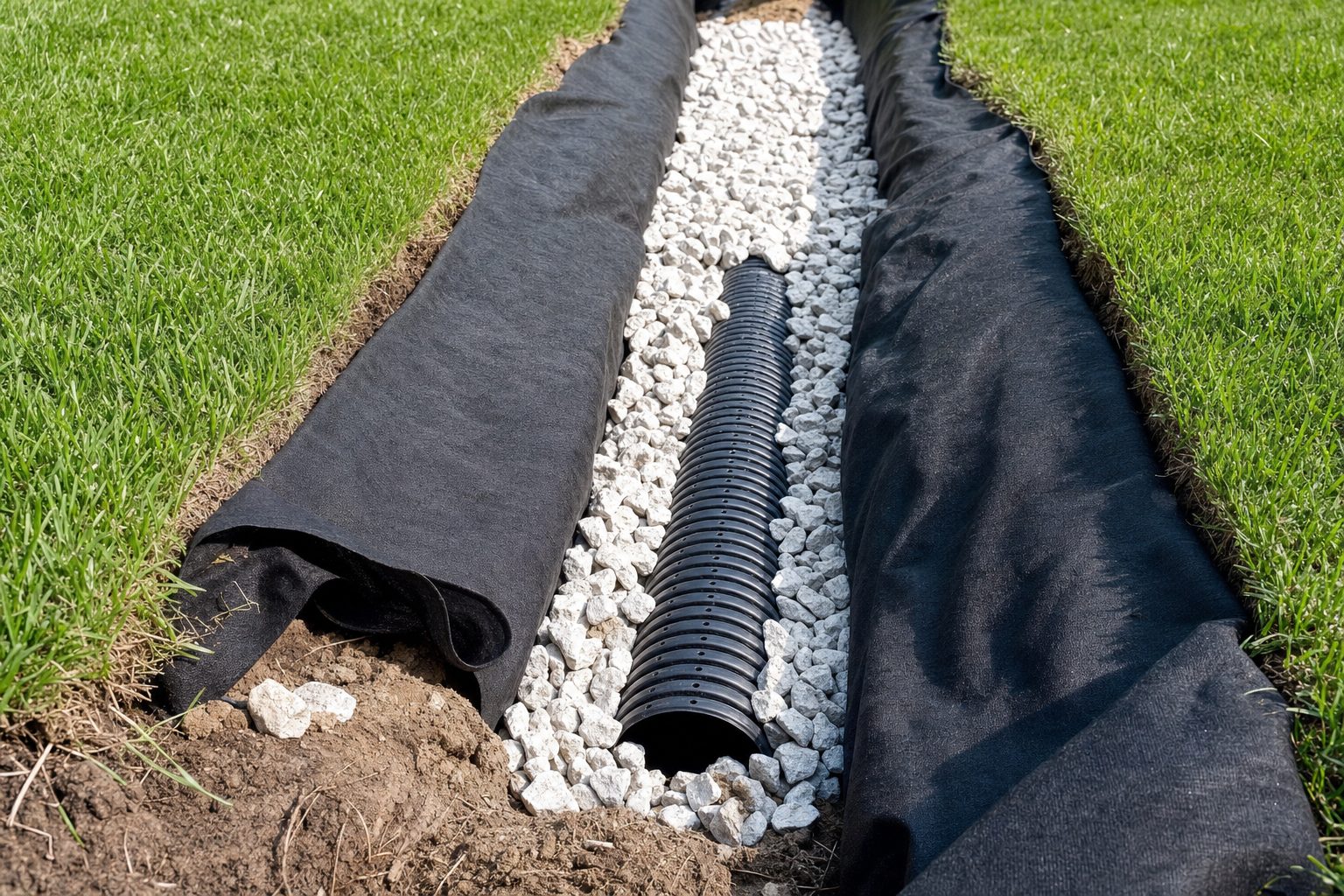
Where a real system is warranted, we install exterior footing drains with clean stone and filter fabric, French drains and curtain drains to intercept upslope water, sump basins and discharge lines, window well drains, and re-graded aprons that carry water away from the structure. Every drain we install has a defined outfall — a drain that goes nowhere is just a buried pond.
Yard Drainage, Swales, Culverts & Storm Structures
Yard-scale work includes catch basins and grated inlets, solid and perforated pipe runs, dry wells, channel drains at garage doors and patios, stabilized swales, rip-rap outfalls and level spreaders. For driveways and roads we install and reset culverts, headwalls, end sections and ditch lines that keep the crown draining and the shoulders intact. Undersized or crushed culverts are one of the most common causes of washed-out rural driveways.
On commercial sites we install storm drainage systems to plan: pipe, manholes, inlets, detention and retention basin grading, outlet control structures, and the erosion and sediment control that keeps the site compliant during construction. That work dovetails with our commercial construction and retaining wall scopes when grade changes need structure.
Erosion Control, Stabilization & Restoration
Bare, freshly graded soil is a liability until it is stabilized. We install and maintain silt fence, inlet protection, check dams, construction entrances, erosion control blanket and matting, and we finish disturbed areas with topsoil, seed, straw or sod so the grade you paid for stays where we put it. On slopes and channels we use matting, rip-rap or turf reinforcement sized to the expected flow.
Restoration also means leaving your property looking cared for — ruts repaired, spoil removed, gravel raked, and a walk-through with you before the last truck leaves. Serving property owners in Virginia, Florida, Utah, California and Wyoming.
Scope of work
What’s Included
Grading and drainage scopes are written around your site’s specific water problem. A typical package includes:
- Site assessment and water-path diagnosis
- Elevation shots and grade staking coordination
- Clearing, grubbing and topsoil stripping
- Cut-and-fill earthwork and site balancing
- Structural fill and compaction in lifts
- Rough grading to design elevations
- Finish grading of pads, slabs and lawn areas
- Stone base placement and compaction
- Positive drainage slope away from structures
- French drains, curtain drains and footing drains
- Catch basins, inlets, pipe runs and dry wells
- Culvert installation, replacement and headwalls
- Swale shaping, rip-rap and stabilized outfalls
- Downspout tie-ins and sump discharge lines
- Silt fence, matting and erosion control
- Topsoil respread, seed, straw or sod restoration
Water Going Where It Shouldn’t?
Send photos of the wet spot, the basement wall, or the driveway that pitches the wrong way. We will tell you what is actually causing it and what the fix costs.
How we work
Our Grading & Drainage Process
Diagnose, design, build, stabilize. Skipping the first step is why drainage work gets redone.
Diagnose The Water
We walk the site, often during or after rain, shoot elevations and trace where water enters, collects and needs to go.
Design The Fix
Grades, pipe sizes, structures and outfall are laid out — coordinated with your engineer’s plan when one exists.
Build It Right
Excavate, install pipe and structures on proper bedding, compact backfill in lifts, and grade to verified elevations.
Stabilize & Verify
Topsoil, seed, straw or matting go down, then we water-test where practical and walk the finished grade with you.
Keep it under one contract
Grade First, Then Build
Grading and drainage are the least glamorous line items on any estimate and the ones that protect everything else you spend money on. Concrete, asphalt, hardscapes, framing, finishes — all of it depends on a site that sheds water and a subgrade that does not move.
Whether it is one soggy corner of a yard or a full commercial stormwater package, tell us about the site and we will price it honestly.
Answers
Frequently Asked Questions
What homeowners, builders and property managers ask about grading and drainage.
Why is water pooling next to my foundation?
Nine times out of ten the finished grade slopes toward the house instead of away, downspouts dump at the wall, or an old footing drain has silted shut. Building codes generally want the ground to fall roughly six inches over the first ten feet away from the foundation. We shoot actual elevations rather than guessing, then fix the cause — which is often far cheaper than the interior system someone else quoted.
Will a French drain solve my drainage problem?
Sometimes, but not always. A French drain intercepts and redirects subsurface and upslope water, and it only works if it has a lower discharge point to run to. If the real issue is negative grade or a blocked culvert, regrading or replacing that culvert is the cheaper and more durable fix. We diagnose before recommending a system.
How long does grading and drainage work take?
A residential regrade with downspout extensions and a short drain line is often one to three days. A full lot regrade with multiple structures runs about a week. Commercial storm systems and detention grading are measured in weeks and are driven by the plan, weather and inspection schedule. Wet weather delays compaction, and we will not compact saturated soil just to stay on schedule.
Do you need a permit for drainage work?
Small yard drainage on private property often does not, but anything that alters a drainage way, discharges onto a neighboring property, disturbs significant acreage, or ties into a public storm system usually does. Rules vary widely across the five states we serve. Our office confirms the requirements before work begins.
Can you fix a washed-out gravel driveway or road?
Yes. Usually the repair is a package: reshape the crown and ditch lines, replace or add culverts sized for actual flow, rebuild the base with compacted stone, and stabilize the shoulders and outfalls. Simply dumping new gravel on a road with no drainage buys a few months at most.
Ready For A Free Written Estimate?
Call either number, or send your project details and an estimator will follow up — usually the same business day. Serving Virginia, Florida, Utah, California and Wyoming.