Decks & Fencing
Deck Builder & Fence Contractor
Decks and fences look like carpentry projects and behave like structural ones. Footings below frost, correct ledger attachment and flashing, code-compliant guards and stairs, posts set so a February wind does not lay your fence in the yard.
Overview
Built To Code, Built To Stand Up To Weather
The most common deck failures are not rotten boards — they are ledger connections that were nailed instead of properly fastened and flashed, footings too shallow for the local frost depth, guardrails that will not take the required load, and stair geometry that fails inspection or trips people. As a general contractor, we build decks as structures: permitted, inspected, and detailed at the connections where they actually matter.
We build pressure-treated and composite decks, multi-level decks, screened porches and three-season rooms, covered porches and roof extensions, pergolas and shade structures, deck stairs and landings, dock and ramp structures where site conditions allow, plus complete railing systems in wood, composite, aluminum and cable.
On the fence side we install privacy and board-on-board, shadowbox, picket, post-and-rail, vinyl, aluminum ornamental, chain link, welded wire and agricultural fencing, plus gates from a single walk gate to double drive gates with automated operators. Our excavation equipment means post holes get dug and set correctly even in rock, clay or roots. Related: hardscapes and retaining walls and concrete.
Custom Deck & Porch Construction
Every deck we build starts with framing math, not board selection: joist span and spacing for the decking material and live load, beam sizing, post and footing sizing, lateral load connections, and a ledger attachment detail with proper flashing so water never gets behind the band board. Footings are dug below the local frost line and bell-bottomed or sized for the load, with brackets that hold posts up off the concrete so they do not wick moisture and rot.
Material choice is a genuine budget conversation. Pressure-treated pine is the least expensive up front and requires periodic cleaning and sealing. Composite and PVC decking cost more initially and dramatically reduce maintenance, with better color retention than early-generation products. Cedar and hardwoods sit in between with their own upkeep. We install hidden fasteners, picture-frame borders, under-deck drainage, lighting and screening — and we will tell you which upgrades actually pay off.
Fence Installation: Privacy, Ornamental & Farm
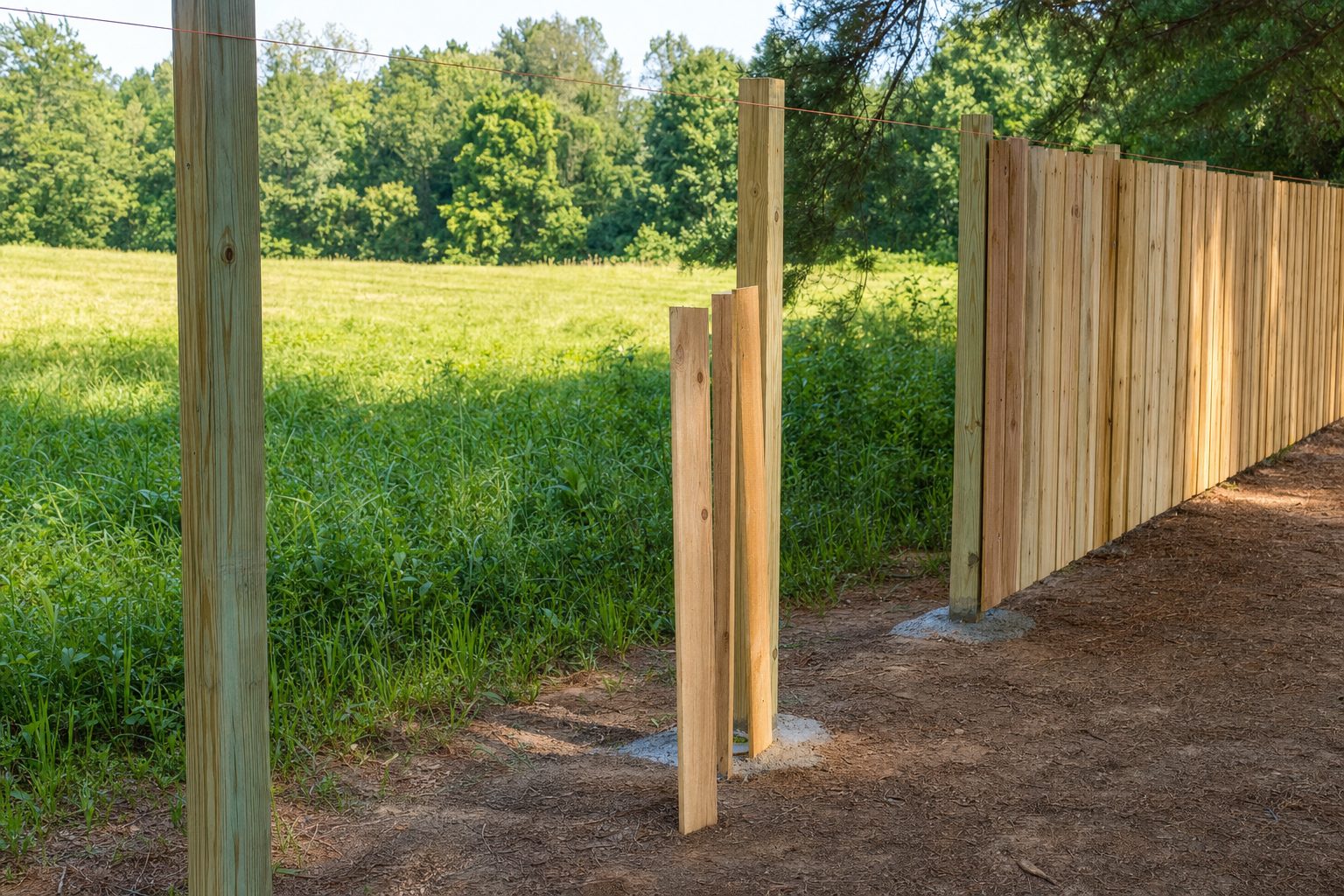
Good fence work starts before the first hole: locating property lines from your survey or plat rather than a guess, confirming any HOA or local height and material restrictions, and calling 811 because there is nothing quite like putting an auger through a buried service line. We set posts in concrete at the depth the fence type and soil demand, string lines for straight runs, keep tops consistent on rolling ground, and hang gates with hardware sized for the gate’s weight.
Options include board-on-board and shadowbox privacy for neighborhoods, vinyl for low maintenance, aluminum ornamental for pool code compliance and clean sightlines, chain link for security and dog runs, and high-tensile, welded wire, woven wire and post-and-rail for farms and acreage. Rural clients often combine fencing with fence line clearing so the line can actually be reached and maintained.
Gates, Automation & Pool Code Compliance
Entrance gates make a property, and they are more technical than they look: post and footing sizing for the gate weight and wind load, swing versus slide based on grade and space, conduit for power and safety loops, keypads, intercoms, solar options for remote sites, and safety edges and photo eyes. We set the footings and conduit correctly the first time and coordinate the operator installation.
Pool fencing carries specific safety code requirements — minimum height, maximum gaps, no climbable horizontals, and self-closing, self-latching gates with latch height requirements. Those rules exist because children drown in unfenced pools, and they are enforced at inspection. We build pool enclosures to the code your jurisdiction applies, alongside pool deck hardscaping when the whole area is being finished at once.
Repair, Restoration & Whole-Yard Projects
We repair and restore as well as build new: replacing rotten deck boards and framing, re-flashing failed ledger connections, sistering or replacing undersized joists, rebuilding stairs to code, resetting leaning fence posts, replacing storm-damaged sections, and cleaning, sanding and re-staining sound structures. A deck with a bad ledger or failing footings is a genuine safety issue — get it inspected before hosting a crowd on it.
Because we run the whole project, a backyard package can include a deck, a patio, a retaining wall, drainage correction, fencing and a door or slider installed to reach it, all on one schedule and one contract. Request a free estimate and we will price the pieces individually so you can phase them if you want.
Scope of work
What’s Included
Deck and fence estimates list materials, footing depth, hardware and finish so nothing is assumed. Typical scope:
- Design consultation and material selection
- Permit application and inspection coordination
- Property line and setback verification
- 811 utility locates before augering
- Footings dug and poured below frost depth
- Framing per span tables with structural hardware
- Flashed and properly fastened ledger attachment
- Pressure-treated, cedar, composite or PVC decking
- Railing systems in wood, composite, aluminum or cable
- Stairs, landings and code-compliant guards
- Screened porch, pergola and shade structures
- Under-deck drainage and low-voltage lighting
- Privacy, picket, vinyl, aluminum and chain link fence
- Farm, welded wire and post-and-rail fencing
- Walk and drive gates with proper hardware or operators
- Cleanup, haul-off and final walk-through
Planning A Deck Or Fence Line?
Give us rough dimensions or linear footage and your material preference. Free written estimates, and we will flag any permit or HOA issues we spot.
How we work
Our Deck & Fence Process
Layout, permits, footings, then carpentry. Doing it in that order is what keeps the finished work standing straight.
Design & Select Materials
We measure, discuss layout, height and materials, and give you options at different price points with maintenance trade-offs.
Permits & Lines
Permits are filed where required, HOA rules checked, property lines verified and 811 locates requested.
Footings & Framing
Footings go below frost depth, framing follows span tables with structural hardware, ledgers are flashed and fastened correctly.
Finish & Inspect
Decking, railing, gates and hardware are installed, the site is cleaned, and we walk the finished work with you after inspection.
Keep it under one contract
One Crew For The Whole Backyard
Decks, patios, walls, drainage and fencing all occupy the same square footage and get in each other’s way when four different contractors show up on their own schedules. Running the package through one general contractor means the footings, sleeves and grades all account for each other.
Tell us what you want the space to do and we will price the whole thing — or just the part you are ready for. See all our services or check availability in Virginia and our other states.
Answers
Frequently Asked Questions
Deck and fence questions we hear on nearly every estimate.
Do I need a permit to build a deck or install a fence?
Decks attached to a house almost always require a building permit and inspections, and freestanding decks above a certain height usually do as well. Fences often require a permit too, especially around pools or above a certain height, and HOAs frequently add their own material and height rules. We check the requirements in your jurisdiction and handle the applications.
Is composite decking worth the extra cost?
It depends on how long you will own the home and how much maintenance you want to do. Composite and PVC decking cost noticeably more up front but do not need sanding, staining or sealing, and modern products hold color far better than early generations. Pressure-treated pine costs the least initially but needs cleaning and sealing every couple of years to look good and last.
How deep do fence posts and deck footings need to be?
Deck footings must extend below the local frost line, which is a very different number in Wyoming than in Florida, and must be sized for the load they carry. Fence posts are generally set roughly one third of the post's above-ground height into concrete, deeper for tall privacy fence, gate posts and windy exposures. We build to the depth your local code and soil conditions require.
How long does a deck or fence project take?
Most residential fence installs run one to three days once materials are on site. A typical deck takes roughly one to two weeks depending on size, height, railing type and inspection scheduling. Screened porches and covered structures take longer because roofing, electrical and finish work are involved.
Can you replace just part of my old deck or fence?
Yes. We replace rotten boards and framing members, rebuild stairs to current code, re-flash failed ledger connections, reset leaning posts and replace storm-damaged fence sections. During the estimate we will be honest about whether repair is a good value or whether the structure has reached the point where replacement costs less over the next decade.
Ready For A Free Written Estimate?
Call either number, or send your project details and an estimator will follow up — usually the same business day. Serving Virginia, Florida, Utah, California and Wyoming.