Land Clearing & Forestry Mulching
Land Clearing & Forestry Mulching
Overgrown acreage, a wooded building lot, a fence line swallowed by brush, or a right-of-way nobody has touched in fifteen years — we open it up. Forestry mulching where you want the ground protected, full clearing and grubbing where you need bare dirt.
Overview
Two Ways To Clear Land — And Why It Matters
There is more than one right way to clear a property, and choosing wrong costs money. Forestry mulching grinds standing brush, saplings and small trees into a mulch layer that stays on the ground, holding soil, suppressing regrowth and leaving nothing to haul away. Conventional clearing and grubbing removes trees, root balls and stumps entirely, which is what you need when a foundation, road, pond or utility corridor is going in the same footprint.
Beast Construction Inc does both, and we will tell you which one your project actually calls for. A landowner who wants to reclaim thirty acres of pasture and see the property line again is a mulching job. A builder who needs a two-acre pad at final grade in three weeks is a clearing, grubbing and grading job. Sometimes it is both: mulch the perimeter and trails, hard-clear the building envelope.
We work across Virginia, Florida, Utah, California and Wyoming, and clearing conditions in each are different — Southside Virginia hardwood and pine with heavy vine understory, Florida palmetto and dense scrub, Utah and Wyoming sage, juniper and cedar, California brush with wildfire fuel-reduction goals. The equipment and the plan change with the vegetation.
Forestry Mulching: Clear Without Wrecking The Ground
A mulching head on a tracked carrier can process material up to roughly eight to ten inches in diameter in a single pass, turning brush, briars, saplings and small trees into a uniform mulch mat. Because nothing is dug or piled, you get no burn piles, no haul-off trucking, no torn-up topsoil and no erosion problem the day after we leave. On sloped ground and near creeks and wetlands, that mulch layer is often the difference between a clean job and a sediment violation.
Mulching is the cost-effective choice for pasture reclamation, wildlife and hunting plots, trails and shooting lanes, fence line clearing, cedar and juniper control, view corridors, wildfire fuel reduction around structures, and general property cleanup. Because it can usually be done in one mobilization with one machine, it is often dramatically cheaper per acre than cut-pile-burn-haul clearing.
Full Clearing, Grubbing & Stump Removal
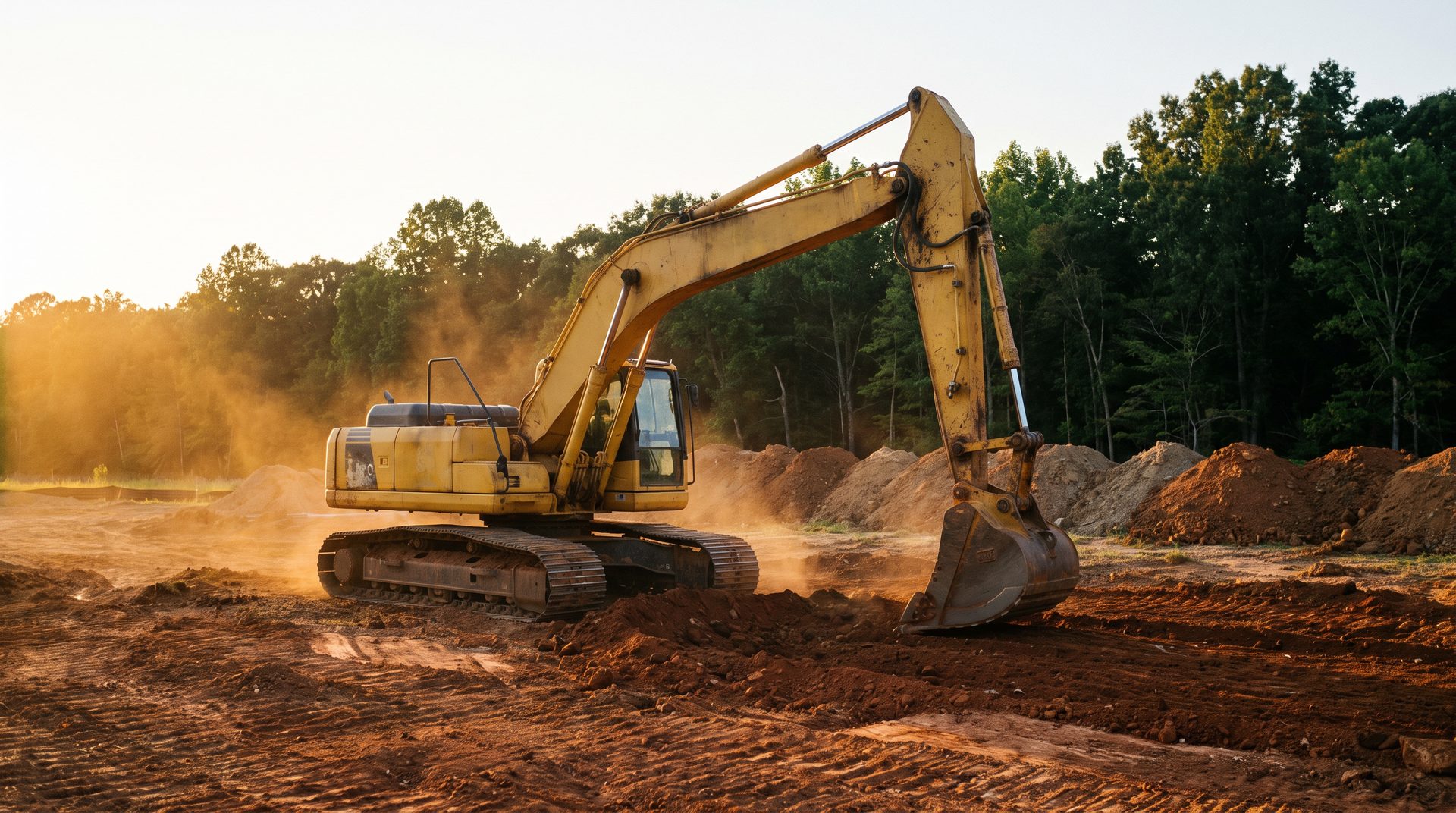
When the ground has to be built on, mulch is not enough. Clearing and grubbing means merchantable timber is dropped and set aside or sold, remaining trees and root balls are removed, stumps are pulled or ground, and the debris is chipped, burned under permit, or hauled off. The result is a clean, gruntable subgrade ready for topsoil strip, cut and fill, and excavation.
Grubbing matters more than people expect. Buried stumps and organic material rot, void out, and settle — and they settle right under whatever you built on top of them. We remove organics from structural areas, backfill and compact the voids properly, and document it. Root balls left in a future parking lot or slab area are one of the most common reasons cheap clearing turns into expensive repair.
Lot Clearing, Right-Of-Way & Commercial Clearing
For builders and developers we clear residential lots, subdivision roads, utility and pipeline corridors, solar and laydown pads, and commercial sites — with the erosion control, tree protection fencing and limits-of-disturbance staking your permit requires. We keep specimen trees your plan calls out, protect their root zones, and stay inside the disturbance limits so nobody has a conversation with an inspector.
Utility and access corridors are a natural fit for us because the same company can clear, then trench and place the underground utilities, then restore and seed. On commercial sites the clearing crew rolls straight into commercial site development without a gap in the schedule or a finger-pointing seam between contractors.
Storm Cleanup, Overgrowth & Fire Mitigation
After a storm, downed timber and hangers are both a hazard and a liability. We clear blowdown, remove damaged trees away from structures, grind stumps, and haul or mulch the debris. For fire-prone areas in California, Utah and Wyoming, we thin ladder fuels and create defensible space around homes, barns and outbuildings following the spacing guidance your local fire authority publishes.
Have a rural property you want usable again? Most owners bundle clearing with a driveway or access road, culvert crossings, and sometimes a pole barn — one mobilization, one contract, one schedule. Serving landowners throughout Virginia and our other four states.
Scope of work
What’s Included
Every clearing estimate defines the vegetation being removed, the finished condition of the ground, and what happens to the debris. Typical scope includes:
- Property walk and vegetation density assessment
- Clear limit and tree protection staking
- Forestry mulching of brush, briars and saplings
- Selective thinning and view corridor clearing
- Timber felling and merchantable log staging
- Stump grinding or full root ball removal
- Grubbing and organic removal in structural areas
- Fence line, trail and shooting lane clearing
- Right-of-way and utility corridor clearing
- Pasture and field reclamation
- Wildfire fuel reduction and defensible space
- Debris chipping, permitted burning or haul-off
- Silt fence and erosion control installation
- Rough grading of cleared areas
- Seeding and straw stabilization on request
- Before-and-after photo documentation
How Many Acres Are We Clearing?
Send acreage, an address or a map pin and we will price it. If you are not sure whether you need mulching or full clearing, ask — that advice is free.
How we work
Our Land Clearing Process
Clearing goes wrong when nobody agreed on what the ground should look like at the end. We settle that first.
Walk The Property
We assess vegetation type and density, terrain, access, wet areas, property lines and anything you want preserved.
Choose The Method
Mulch, clear and grub, or a combination — matched to your end use, budget and permit requirements.
Permits & Protection
Land disturbance permits, burn permits where used, erosion control and tree protection fencing go in before work starts.
Clear & Finish
We clear, handle debris as agreed, rough grade, stabilize disturbed soil, and walk the finished property with you.
Keep it under one contract
Clearing Is Usually Step One
Clearing is rarely the whole project. Because Beast Construction Inc is a full general contractor, the crew that opens up your land can keep going into excavation, drainage, driveways, concrete and structures — without you having to line up four more contractors and hope their schedules agree.
Tell us what you want the property to do, and we will price the path to get there. Request a free estimate or explore all of our services.
Answers
Frequently Asked Questions
The questions landowners ask before they let a machine onto their property.
What is the difference between forestry mulching and land clearing?
Forestry mulching grinds vegetation in place and leaves a protective mulch layer, with no burning, hauling or ground disturbance. Conventional clearing and grubbing removes trees, root balls and stumps completely and leaves bare, buildable ground. Mulching is faster and usually cheaper; grubbing is required anywhere you are going to build, pave or place structural fill.
How much land can you clear in a day?
It depends entirely on density and terrain. Light brush and saplings can move quickly, while mature timber with heavy vine understory takes far longer per acre. After a site walk we can give you a realistic production estimate and a total price rather than a guess over the phone.
Do you leave the trees or haul them away?
Your call, and it is written into the estimate. Merchantable timber can be staged for you or a logger, firewood-sized material can be cut and stacked, and the rest can be mulched, chipped, burned where permitted, or trucked off. Keeping material on site almost always saves money.
Can you clear near creeks, wetlands or steep slopes?
Often yes, but those areas carry rules. Buffers, permitted crossings and erosion control requirements vary by state and county, and wetlands may involve federal review. Mulching is frequently the approved method in sensitive areas because it leaves the root mat and soil intact. We confirm the requirements before we start rather than after.
Do I need a permit to clear my own land?
Frequently, yes — especially over a certain disturbed acreage, near water, or when the clearing is tied to future construction. Burning almost always requires a permit and a legal burn window. Our office checks local requirements in your jurisdiction and tells you exactly what is needed.
Ready For A Free Written Estimate?
Call either number, or send your project details and an estimator will follow up — usually the same business day. Serving Virginia, Florida, Utah, California and Wyoming.